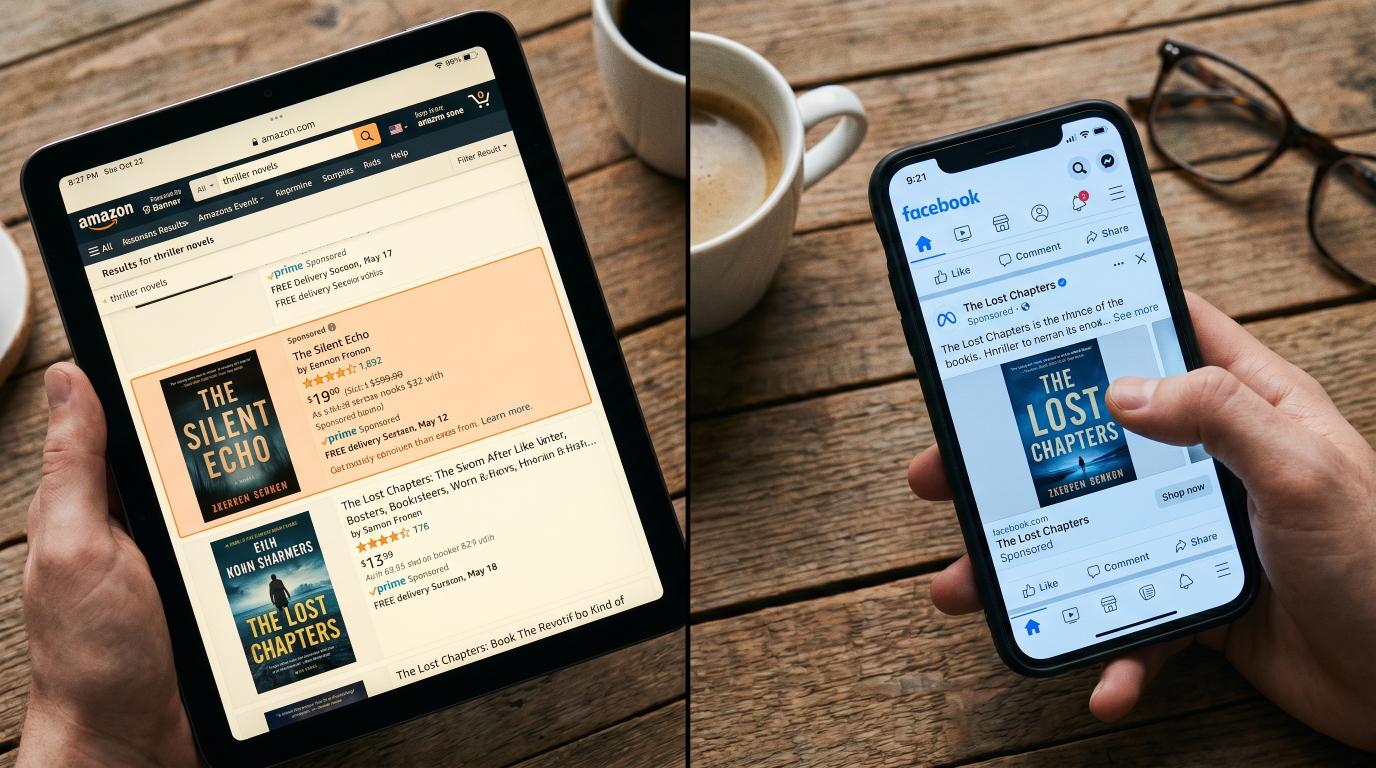
Almost every indie author's first $500 paid-ad attempt loses money. The platform isn't usually the problem — the expectations and the conversion stack are. By the end of this article, you'll know exactly when each platform works, what cost-per-click to expect in your genre, what your Amazon page must look like before either platform will convert, and the honest math on whether ads even make sense for your specific book.
The Quick Answer
For most indie authors, the right call in 2026 is:
- Amazon Ads first — captures readers already on Amazon searching for books like yours
- Facebook (Meta) Ads second — when you have a series and need to drive cold readers to book 1 of a sequence
- Both, scaled together — when conversion stack is proven and budget is $1,000+/mo
Now the detail.
Amazon Ads (Sponsored Products + Sponsored Brands)
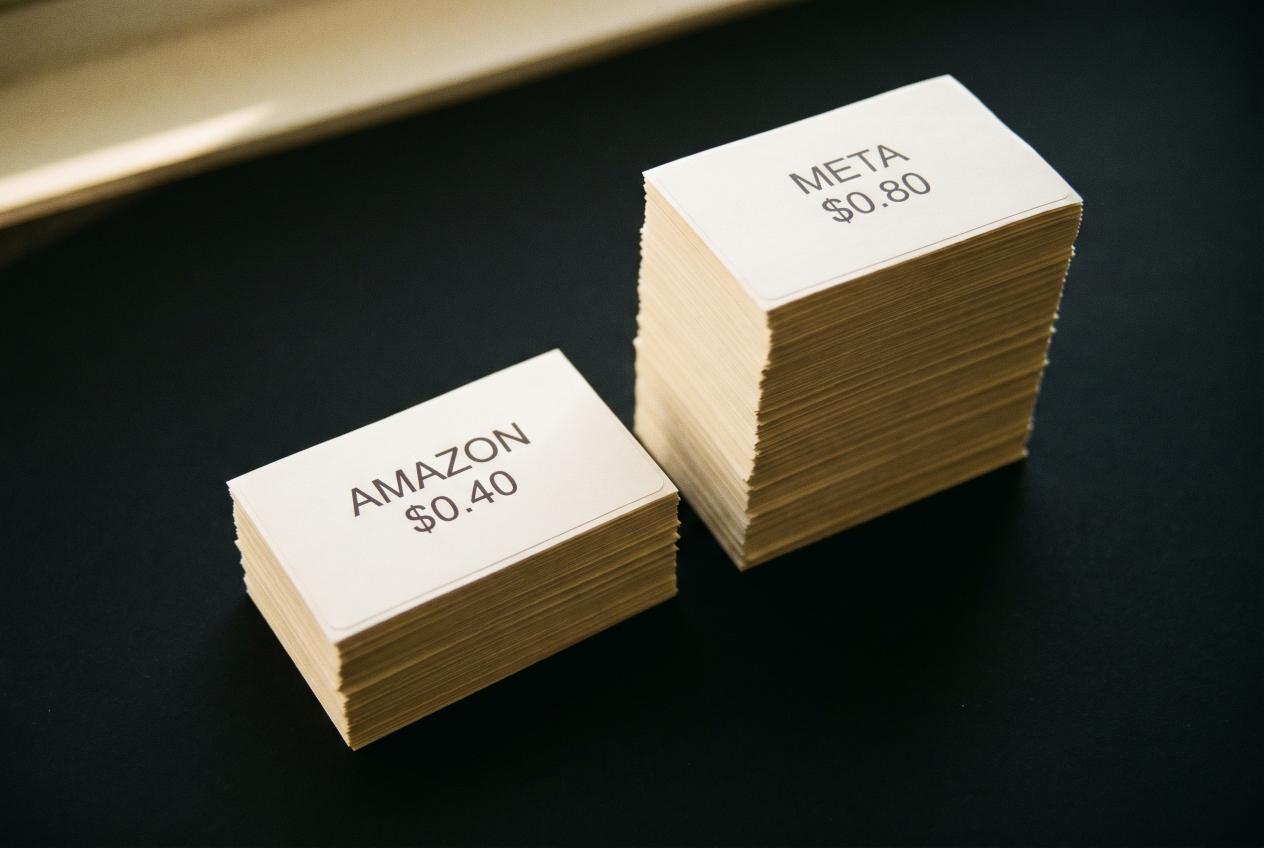
Amazon Ads places your book in three main slots:
- Sponsored Products — appears in search results when readers type book-related keywords
- Sponsored Brands — banner-style ads at the top of search results, branded by author or series
- Lockscreen Ads — Kindle device lockscreen placements (lower volume but cheap)
Cost-per-click in 2026
Realistic CPC ranges by genre:
| Genre | Average CPC |
|---|---|
| Romance (sub-niche) | $0.20-$0.50 |
| Romance (broad terms) | $0.50-$1.50 |
| Mystery / Thriller | $0.30-$0.80 |
| Sci-Fi / Fantasy | $0.20-$0.60 |
| Non-fiction (popular) | $0.40-$1.20 |
| Non-fiction (niche) | $0.20-$0.60 |
| Literary Fiction | $0.30-$0.70 |
| Children's books | $0.40-$1.00 |
These are starting CPCs. Once you have a few weeks of data, smart bid optimization typically lowers your CPC 20-40% by removing low-performing keywords and reallocating to high-converters.
Conversion economics
Amazon Ads have one massive advantage over every other platform: the click goes directly to your Amazon page. There's no friction between "they saw your ad" and "they're staring at your buy button."
Conversion math for a properly-optimized book:
- Click-through rate (CTR) on a good ad: 0.3-0.8%
- Page visit → purchase conversion: 8-15% (if cover, blurb, reviews are strong)
- Effective sales rate from impressions: 0.025-0.12%
For a $4.99 ebook at 70% royalty ($3.49 net):
- At $0.40 CPC and 10% page→purchase conversion = $4 ad spend for one sale
- Negative ROI on the single sale — but Amazon Ads' real value is the read-through to the rest of your series
Where Amazon Ads make money
Amazon Ads break even or profit in three scenarios:
- Series authors — readers who buy book 1 from an ad continue through book 2-5 at full price. Lifetime value per reader much higher than single ebook royalty.
- High-priced non-fiction — $9.99-$19.99 books absorb higher CPC because royalty per sale is $7-$14
- KDP Select / Kindle Unlimited authors — KU page-reads accumulate beyond the initial sale, especially valuable for genres with binge-readers
For standalone fiction at $4.99, Amazon Ads usually break even at best. For series fiction with $0.99 book 1 + full-price book 2-5, ads consistently profit.
Facebook (Meta) Ads
Meta Ads (Facebook + Instagram) reach readers outside Amazon. The audience is broader, less purchase-ready, and harder to convert — but if you can crack it, the volume potential is much larger.
Cost-per-click in 2026
Meta Ads CPC for book targeting runs:
- $0.40-$1.50 for fiction (depending on genre and audience targeting)
- $0.80-$2.50 for non-fiction (especially business / self-help — saturated audiences)
Higher than Amazon Ads, but the audience is much larger and not constrained to current Amazon searchers.
Conversion economics
Meta Ads click → Amazon page → purchase has more friction than Amazon Ads:
- Click-through rate on a strong ad: 1-3%
- Click → Amazon page → purchase conversion: 3-7% (lower than Amazon Ads because the audience is colder)
- Lots of users browse Amazon, then leave without buying that session
The Facebook tracking complication: Apple's iOS 14.5+ privacy changes broke 30-60% of Meta's conversion tracking. You're often spending without knowing if it's converting. Most authors who run Meta Ads now rely on:
- Direct attribution (Amazon's "Royalties" report shows total sales daily — you compare ad-on vs ad-off periods)
- UTM-tagged links to your author website (track newsletter signups as a proxy)
Where Meta Ads make money
Meta Ads work best when:
- You're driving to a free or $0.99 book 1 in a series. The low price overcomes the cold-audience friction.
- You're driving to a free lead magnet on your author site (free novella in exchange for email signup) — captures the reader for long-term funnel without immediate sale pressure.
- You have video creative — short video ads outperform static images by 2-3x on Meta in 2026. Hand-held selfie videos of authors talking about their book convert at higher rates than polished graphic designs.
- You're in a visually-dramatic genre — Romance, Fantasy, Thriller cover artwork pops in feed. Literary fiction and non-fiction underperform because the covers are typographic and feel less "stop-scroll-worthy."
Where Meta Ads usually fail
- Cold-traffic to a paid book — converting a stranger to a paid book purchase via Facebook in one click is genuinely hard
- No funnel — driving to Amazon page with no email capture means you pay for one shot at conversion
- Wrong genre — literary fiction, poetry, niche non-fiction underperform on Meta
The Stack That Actually Works
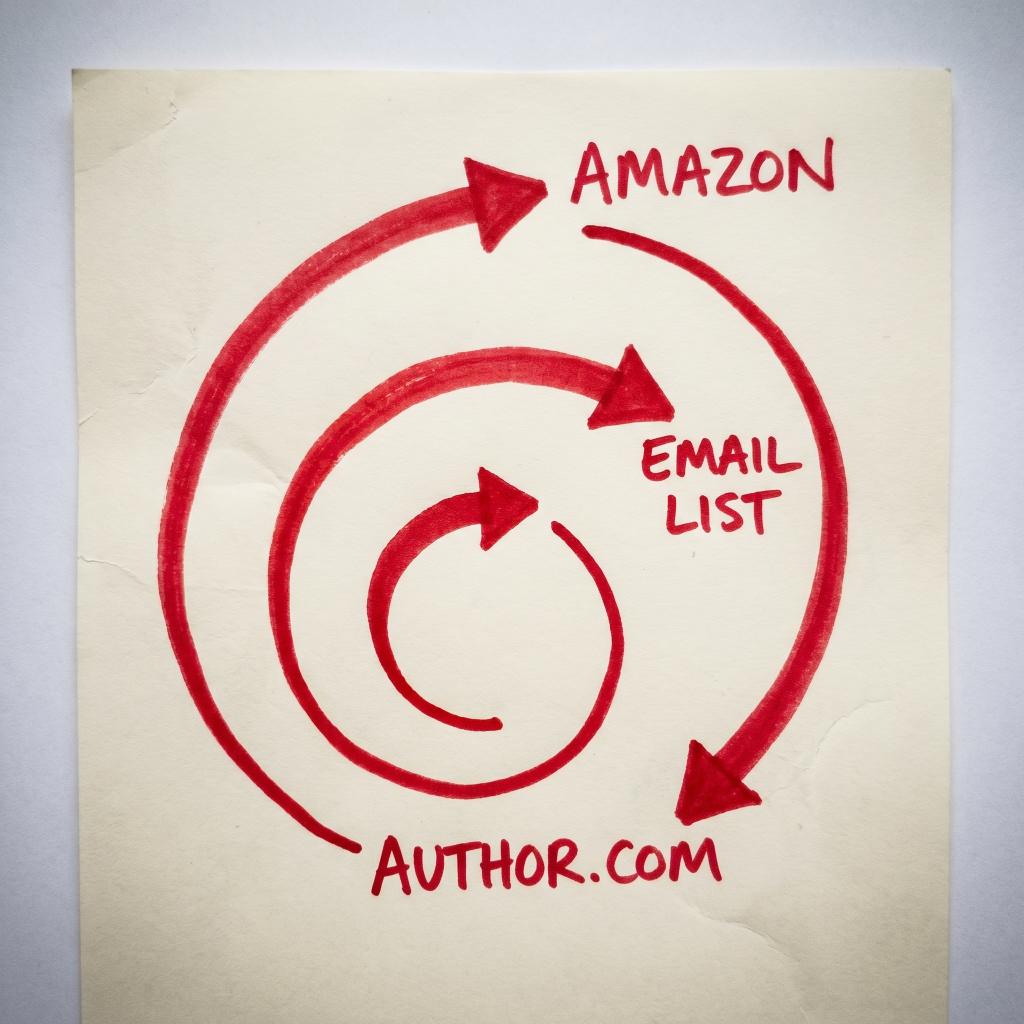
Stop thinking of Amazon Ads vs Facebook Ads as either-or. They serve different jobs:
Amazon Ads job: Capture warm searchers
Readers searching "small town romance" or "cozy mystery" or "ADHD self-help" are already in buying mode. Your ad shows up; conversion is high; CPC is reasonable.
Always run Amazon Ads if you can spare $5-$15/day. Even a small budget produces useful data.
Facebook Ads job: Drive volume from cold audiences (only when ready)
When your conversion stack is already proven (Amazon Ads at break-even or profit, Amazon page converting at 8%+), Facebook Ads can scale by tapping the larger pool of readers who aren't currently on Amazon.
Run Facebook Ads only after Amazon Ads are working. Cold-audience conversion magnifies whatever's broken in your stack.
What to spend on each:
- Total ad budget under $300/mo: 100% Amazon Ads
- $300-$1,000/mo: 70% Amazon, 30% Meta (Meta to drive newsletter signups, not direct sales)
- $1,000+/mo: 50/50 split, with Meta scaled toward funnel-building
What MUST Be True Before Spending Any Ad Money
This is the part articles skip and authors learn the hard way:
Ads amplify your existing conversion rate. They don't fix a broken page.
If your Amazon page converts at 2% (broken — bad cover, bad blurb, no reviews), $1,000 in ads produces 20 sales. If it converts at 12% (working stack), $1,000 in ads produces 120 sales. Same spend, 6x outcome difference.
Before any ad spend, your book must have:
- Cover that passes the thumbnail test — communicates genre in 200px in 0.3 seconds
- Blurb that hooks in the first sentence — promise of emotional experience, not summary
- 10+ reviews with 4.0+ rating — Amazon's algorithm requires this for organic surface
- Right categories — niche enough to compete in. See KDP Categories Optimization.
- A+ Content — the visual content below the fold on Amazon
If any of these is broken, fix the page before spending on ads. Ads on a broken page is just paying to confirm the page is broken.
What Real Press Adds to the Equation
Books that have real magazine press features convert at higher rates from ads than books without — for several measurable reasons:
- "As featured in" trust signal in your A+ Content reduces purchase hesitation by 5-10%
- Reviews bumped by editorial-driven readers (people who came in through magazine articles tend to leave reviews more often than ad-driven readers)
- Better Amazon Ads keyword bidding — Amazon's algorithm increasingly rewards "authority signals," and editorial mentions count
- Higher organic CTR on search results — readers who recognize your author/book from a magazine feature click your search results at higher rates than unfamiliar names
A VUGA 10 + Miami Herald package ($7,997) that places your book in Miami Herald creates the "as featured in" foundation that then makes ad spend produce better ROI. The order matters: press first, ads second. Ads on a press-supported page typically deliver 1.5-2x the ROI of ads on a no-press page.
A Realistic Ad Strategy by Budget
$200/month total
- 100% Amazon Sponsored Products on 5-7 niche keywords specific to your sub-genre
- $7/day budget split across keywords
- Goal: break-even to mild profit, learn what's converting
- Skip Meta until $400+/mo
$500/month total
- 70% Amazon Sponsored Products + Sponsored Brands
- 30% Meta Ads driving to a free lead magnet on your author site (not direct to Amazon)
- Goal: build email list at <$2/subscriber while Amazon Ads break even
$1,000+/month
- 50% Amazon (Sponsored Products + Brands)
- 50% Meta — split between lead-magnet funnel and direct-Amazon (test which performs)
- Goal: scale what's working, kill what's not. Iterate weekly.
When Ads Don't Work for Your Book (And What to Do Instead)
If you've run Amazon Ads at $300-$500/mo for 2 months and you're still losing money on every dollar spent, the problem is almost always one of:
- Cover doesn't communicate genre at thumbnail size → redesign before continuing
- Blurb is a summary not a hook → rewrite
- Under 10 reviews → run an ARC program or get editorial press to drive reader-driven reviews
- Wrong categories → re-optimize per KDP Categories guide
- Genre / cover combination is too generic to stand out in feed
In all of those, stop spending on ads and fix the underlying issue. Continued ad spend just amplifies the broken element.
Bottom Line
Amazon Ads vs Facebook Ads is a false binary. Both serve different jobs in a properly-stacked indie author marketing system:
- Amazon for warm searchers (always running, low cost)
- Facebook/Meta for cold-audience scale and lead-magnet funnels (after Amazon is working)
Neither works without the conversion stack underneath: cover, blurb, reviews, categories, A+ Content, and ideally real magazine press for trust signals.
Spend $300/mo on Amazon Ads, fix any conversion issues you discover, then scale. Skip the temptation to throw money at Meta first — that's how indie authors lose $1,500 in 60 days with nothing to show.
For the trust-signal layer that makes both platforms convert better — magazine logos for A+ Content and signature credibility — see VUGA author packages. Press first, ads second; the order produces the best ROI.
Sources for this article:
- Amazon Advertising, "Best Practices for Books"
- Kindlepreneur, "Amazon Ads for Authors"
- Mark Dawson's Self Publishing Formula, "Facebook Ads for Authors"
- Brian Meeks, "Mastering Amazon Ads"
- BookBub Insights, "Ad Platform Comparison for Authors"