A "publisher" calls or emails you. They want $5,000 to $30,000 to "publish your book and run a marketing campaign." They sound professional. The contract has logos of major retailers on it. They promise bestseller status, magazine features, the whole package.
Are they legit? Or are you about to lose $20,000 to a vanity press repackaged with new marketing language?
This article is the answer. We'll cover what vanity press actually is (and isn't), how "hybrid publishing" muddies the waters, the seven red flags that mean you're being scammed, and how the marketing-first publisher model is different from both.
By the end you'll know exactly what questions to ask before signing any contract.
The Three Models, Plain English
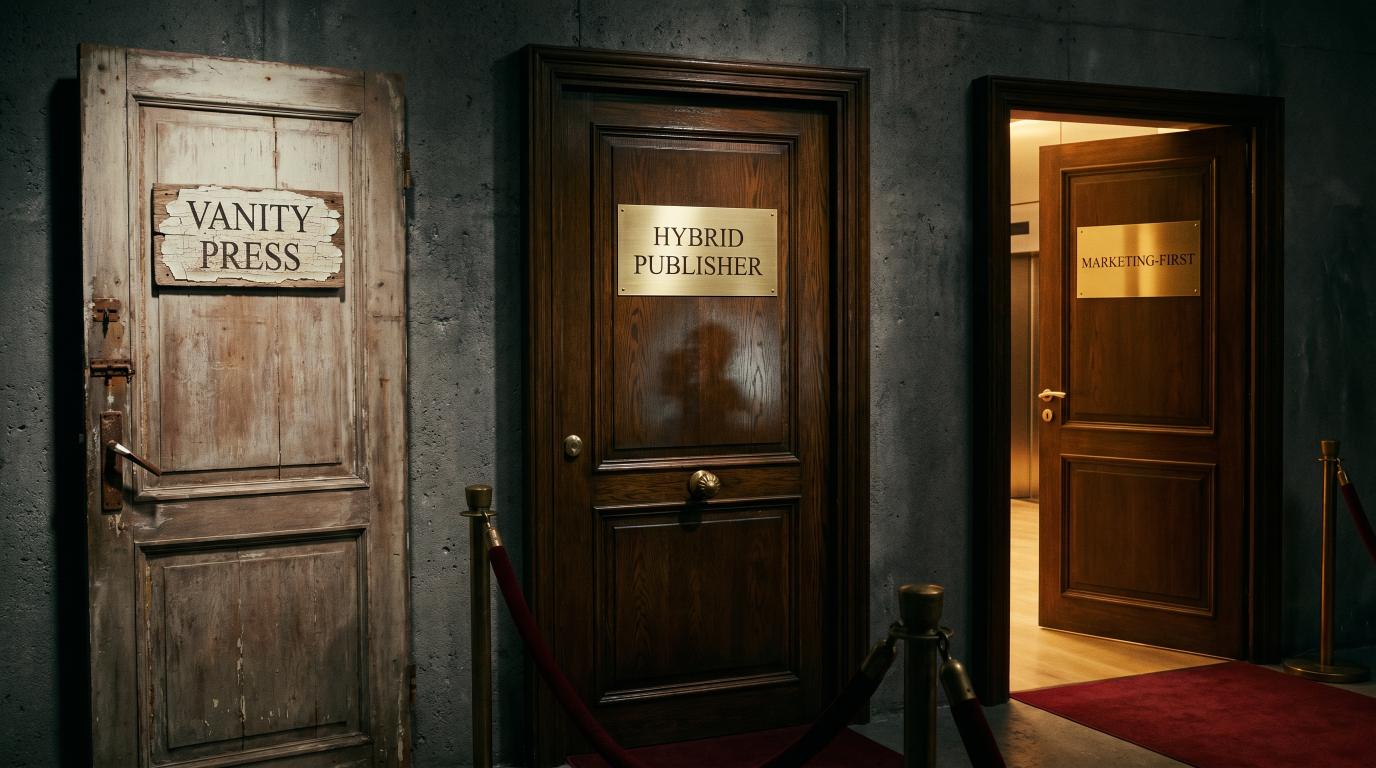
There are three legitimate paid-author-services models in 2026. They look similar from the outside; they're structurally very different.
1. Vanity Press (also called "subsidy publishing")
You pay a publisher to print and distribute your book. The publisher does little to no editorial work, no curation, no marketing — they take any manuscript that comes with a check. Your book gets published, maybe sold through their website, almost never reaches retailers in any meaningful way. The publisher's revenue comes from author fees, not book sales.
Telltale signs:
- They take any manuscript, no editorial review
- The contract has author paying for printing, "marketing services," and "distribution"
- Books are printed on demand or in tiny print runs
- "Distribution" means listing on their own website plus maybe Amazon
- No real bookstore presence
- "Author Solutions" is the most famous example — owned by various large publishers over the years, always rebranded but always the same model
2. Hybrid Publishing (a real model, often abused)
Hybrid publishing is a legitimate and growing model where authors pay part of the publishing costs in exchange for a higher royalty rate, shared marketing investment, and curatorial selection. Real hybrid publishers like She Writes Press, Greenleaf, and Inkshares reject most submissions, do real editorial work, and place books in real retail channels.
Telltale signs of legitimate hybrid:
- Submission process with manuscript review (they don't take everyone)
- Industry-standard royalty rates (50-70% net to author)
- Real editorial team, professional cover design
- Distribution through Ingram or similar (not just Amazon)
- Member of Independent Book Publishers Association or similar
- Public list of titles published, sold in real bookstores
The cost typically runs $5,000–$25,000 depending on services included.
Where it gets ugly: Many vanity presses now call themselves "hybrid publishers" because the term sounds legitimate. They take any manuscript, charge $20K, deliver almost no marketing, and hide behind the new label.
3. Marketing-First Publisher (newer model)
A marketing-first publisher doesn't traditionally publish your book — they market it. You own the book; you upload to KDP / IngramSpark / wherever yourself. The publisher's product is press placement and promotion with contractually-defined deliverables.
Telltale signs:
- They don't print or distribute the book itself — you keep KDP rights
- Pricing is per-deliverable (per-placement, per-campaign), not "publishing services"
- Contracts list specific named outlets where placements will run
- Money-back guarantee on undelivered placements
- Doesn't claim to make you "a bestseller" — claims to deliver specific press at a specific price
VUGA Publishing operates this model. We don't print or distribute books; we deliver guaranteed editorial placements in major celebrity magazines and our owned-network of 140 digital outlets. The book stays on Amazon under your KDP account; you keep all royalties; we handle the press machine.
The Seven Red Flags You're Being Scammed
Whatever model is being pitched to you, run if you see any of these:
Red flag #1: "We'll make you a bestseller"
No legitimate publisher promises bestseller status. Bestseller lists (NYT, USA Today, Amazon Top 100) are gameable in narrow ways but never guaranteed. Anyone promising you a bestseller status before reading your book is selling you something they can't deliver.
The exception: Amazon Sub-Category Bestseller. Some companies promise to land you on a niche category bestseller list (e.g., "#1 in Books > Crafts > Origami > Modern Origami"). That's a real but trivially gameable ranking — buy 50 copies on launch day, you'll hit #1 in any narrow category. It means nothing for sales but it's not technically a lie.
Red flag #2: "Featured in 200+ news sites"
This is wire-service press release distribution dressed up as PR. As we covered in Press Release vs Editorial Article, wire releases get pushed to syndication clones that no human reads, and Google de-indexes most placements within 90 days. The screenshots are real but the placements are worthless.
If they can't name specific real magazines where placements will run, they're selling wire releases, not press.
Red flag #3: Hides pricing behind a "consultation call"
Real publishers and real services publish pricing. Companies that hide pricing behind a sales call do it because the price is custom-set based on how much they think you'll pay, not based on a fixed cost. You'll pay more than the next caller.
If you can't see prices on their website, walk away. Or if you must engage, get the price in writing before the sales call, via email, with the deliverables itemized.
Red flag #4: Outlets you can't verify on Wikipedia
Some scammy "publishers" sell placements in fake outlets — fictional magazines with names that mimic real publications. "Vanity Fair Germany" (real Vanity Fair has no German edition). "Forbes Books Affiliate" (not a real Forbes property). "The Hollywood Voice" (made up).
If you can't find the outlet on Wikipedia or with a real masthead and editorial team, the placement is worthless. VUGA confirms specific named outlets in writing before purchase — Miami Herald (miamiherald.com), TIME (time.com), etc. — and you can verify all of them yourself.
Red flag #5: High-pressure sales tactics
"This pricing is only available today." "We can only take three new authors this month." "If you don't sign in 48 hours, the slot goes to someone else."
Real publishers don't operate this way. Pressure tactics exist to override your due-diligence period. Walk away from any service that creates artificial urgency.
Red flag #6: Royalty grabs in the contract
Look for clauses that give the publisher rights to your book content, royalties, or derivative works. Vanity presses sometimes embed permanent royalty splits or rights grabs in contracts dressed up as marketing services. You should retain 100% of book royalties — anything else is a structural transfer of value from you to them.
VUGA's contract is explicit: we get a non-exclusive license to use book metadata (title, cover, synopsis, author name) for placement purposes only. We claim no royalty on your book sales, no rights to derivative works, no IP grabs. Anything less is a red flag.
Red flag #7: No money-back if they don't deliver
If the contract doesn't have a money-back guarantee for failed deliverables, you're paying for effort, not outcome. That's the structural flaw of traditional book publicity — you pay $15K for someone to try to land features.
Marketing-first publishers fix this by guaranteeing specific deliverables with refunds for non-performance. VUGA's Promise is explicit: if we fail to publish a placement listed in your purchased package on the named outlet within the stated delivery window, you get a full refund of that placement's portion. No fine print. No fight.
How to Vet Any Paid Publisher / Service
Before signing any contract over $1,000, do this:
- Search "[company name] reviews" + "scam" — read 10 minutes of complaints
- Look up specific outlet names from their pricing on Wikipedia — confirm they're real publications with real editorial teams
- Check if they're a member of IBPA — IBPA membership doesn't guarantee quality, but it's a credibility signal
- Ask for three recent client references — not testimonials on their site, real authors you can email
- Read the contract — specifically for: money-back guarantee, royalty/rights claims, named deliverables vs vague "campaigns"
- Check the Better Business Bureau rating
- Run the company name through Writer Beware — the SFWA-maintained list of known scammers
This is 30 minutes of work. It saves authors thousands.
The Marketing-First Model in Plain English
The reason VUGA Publishing's model is different from vanity press OR hybrid:
- You retain all rights to your book. We don't republish it; you keep your KDP account, your royalties, your IP.
- No print runs to "buy back" later. Vanity press classics — "we'll print 1,000 copies and sell them in your local stores" — don't exist in our model.
- Specific named deliverables — every placement is in a magazine we name in writing, on a digital domain you can verify with one Google search.
- Money-back guarantee if any placement fails — written into our Terms, not a verbal promise.
- Pricing is public — Network Article $300, 10 Network Articles $3,000, 10 + Miami Herald $7,500, 10 + Celebrity Bundle $14,997, premium add-ons listed openly. No "consultation calls" to extract custom pricing.
If a "publisher" can't answer any of those points cleanly, they're either vanity press or hybrid-press abusing the label. The structural test: do they make money from author fees, or from book sales? Vanity press makes money from author fees (which is why they'll publish anyone with a check). Real hybrid publishers split the cost-and-royalty equation. Marketing-first publishers charge for the marketing service explicitly — and the customer keeps 100% of book sales.
Bottom Line

Vanity press still exists. It's just rebranded itself constantly — "subsidy publishing," "self-publishing services," "hybrid publishing," "author-partner press." The structural test stays the same: do they take any manuscript? Do they hide pricing? Do they refuse to name specific outlets? Do they grab rights or royalties? Are deliverables guaranteed?
If yes to any of those — keep walking.
The marketing-first model is a separate category. You stay in control of your book; you pay for specific marketing deliverables; the contract guarantees what you're buying. If you want to see what that looks like at a price that doesn't require a sales call, browse VUGA author packages — every price published, every deliverable named, every placement guaranteed.
Sources for this article:
- Independent Book Publishers Association, "IBPA Hybrid Publisher Criteria"
- Writer Beware (SFWA), "Vanity Publishers"
- Jane Friedman, "Hybrid Publishing: A Comprehensive Guide"
- Reedsy, "Hybrid Publishing: 12 Things to Know Before Hiring One"
- Better Business Bureau, Publishing Service Scam Reports