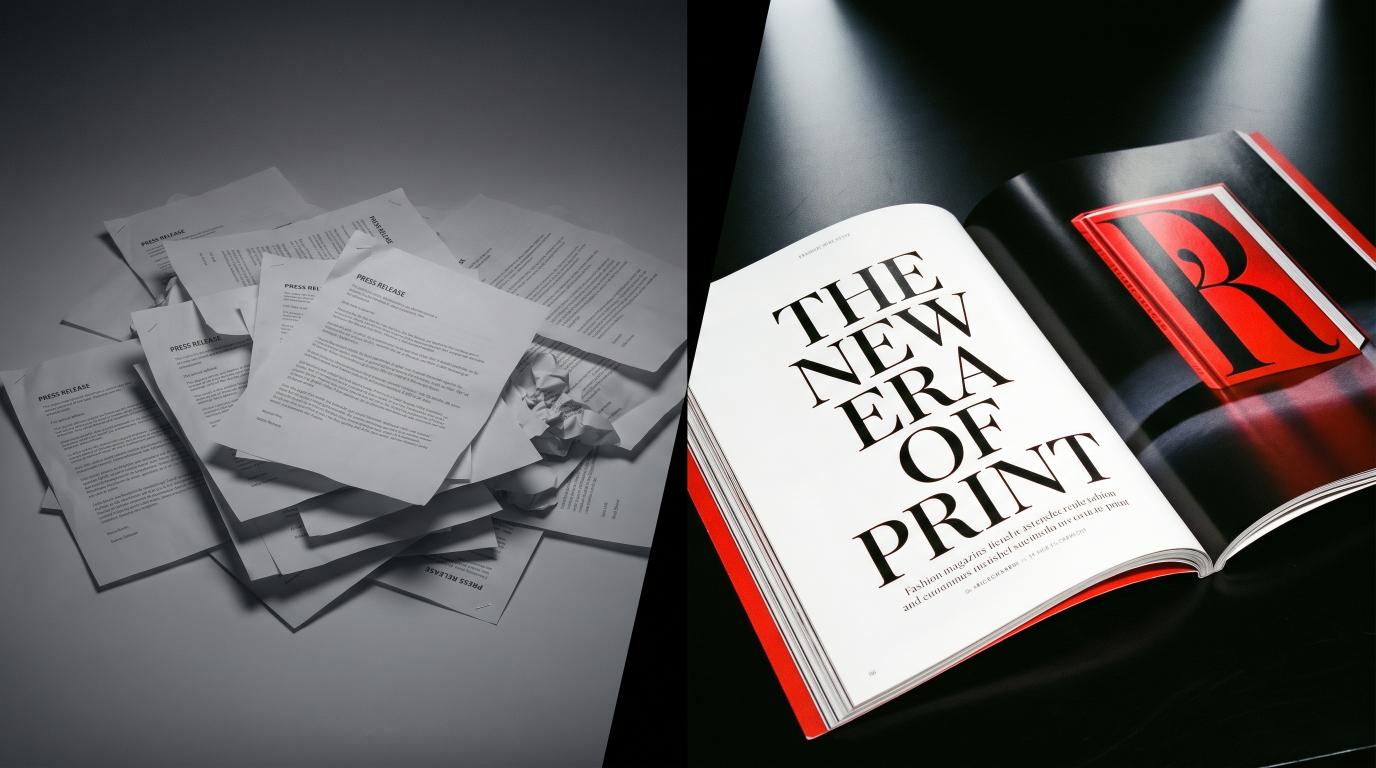
You've been pitched both. Some company says "we'll distribute your press release to 200+ news sites for $497." Another says "we'll write an editorial article placed in Miami Herald for $7,997." They both call themselves "book PR." Neither one explains the actual difference.
This article is the explanation.
By the end you'll understand why these two products share a category label but produce completely different outcomes — one gets de-indexed by Google in 90 days, the other becomes a permanent surface that drives readers to your book for years. And you'll know which one to spend money on, depending on what you actually want.
The Quick Version
| Feature | Press Release Distribution | Editorial Article |
|---|---|---|
| Format | Boilerplate announcement, third-person | Original story, journalistic voice |
| Where it lives | Wire-service syndication clones (Yahoo Finance shadow pages, Benzinga partner feeds) | The actual magazine's domain (miamiherald.com, time.com, etc.) |
| Author | You write it | An editor at the magazine writes it (or VUGA's editorial team writes in the magazine's voice) |
| Reads like | A corporate ad | A real story |
| Google treats it as | Often duplicate content; de-indexed within 90 days | High-authority editorial content; ranks indefinitely |
| Who reads it | Almost nobody — bots and SEO scrapers | Readers of the magazine |
| Domain authority bonus | Mostly low-DA sites | Tier-1 magazine domain (DA 80+) |
| Cost range | $300–$2,000 | $997–$15,000 (depending on outlet tier) |
| Real magazine feature? | No | Yes |
One-line summary: A press release is a corporate blast that gets ignored. An editorial article is a real story that gets read.
What Wire-Service Press Releases Actually Are

Most "book PR services" priced under $2,000 are wire-service press release distribution dressed up with marketing language. Here's the actual pipeline:
- You (or the service) writes a 400-word press release in a stilted, third-person announcement format. Example opening: "Author Sarah Smith is pleased to announce the release of her debut novel, Vermont Hearts, available on Amazon and Barnes & Noble."
- The release gets pushed to a wire — PR Newswire, EIN Presswire, GlobeNewswire, AccessWire, or one of dozens of cheaper imitators.
- The wire automatically syndicates the release to its partner network. This is where the screenshots come from: "appeared on 200+ news sites!" Most of those sites are syndication clones of legitimate news brands — Yahoo Finance partners, Benzinga affiliates, MarketWatch shadow pages. None of them have human readers; they exist to host syndicated content for SEO juice that never materializes.
- Within 30–90 days, Google's duplicate-content filters identify the release as a syndicated copy and de-index most placements. The screenshots remain (the URLs technically still exist), but they no longer surface in search.
According to v2com's analysis, the press release is "more time sensitive" — it's designed to ride a news cycle, not to live as a referenceable article.
When wire-service press releases are worth the money
For self-published authors: almost never. The exceptions are narrow:
- You're filing a release for a genuinely newsworthy event (book debut at #1 in a major retailer, major award win, celebrity endorsement) and want a few quotable mentions in the news cycle
- You need a few dozen low-quality backlinks for SEO purposes (and you already have a robust SEO foundation, not a 5-page author site)
- You want to look "professional" on a media kit by listing news mentions
For everything else — driving readers, building authority, establishing your book on real cultural surfaces — wire-service press releases do nothing. The format is wrong, the venues are wrong, and the longevity is zero.
What Editorial Articles Actually Are
An editorial article is a different product. It's not an announcement — it's a piece of journalism written by an editor, formatted in the host magazine's voice, published on the magazine's actual domain.
Here's what makes it structurally different:
1. It reads like a real story
The format is a reported feature: a hook (something readers care about), a narrative (the author's story or the book's premise framed as a human-interest angle), supporting detail, quotes, a payoff. There's no "the author is pleased to announce." Readers don't skip it because they recognize it as marketing.
2. It lives on the actual magazine domain
When you buy an editorial placement in Miami Herald, the article is on miamiherald.com. Not a syndicated partner. Not a shadow page. The same domain that hosts the magazine's celebrity coverage, sitting on the same content management system, getting the same domain authority lift.
3. Google rewards it differently
The Ideal Marketing Company puts it cleanly: editorial articles "stay relevant longer" and "benefit from an SEO perspective through links back to your website." That backlink from a tier-1 magazine — miamiherald.com or time.com — is one of the most valuable signals you can earn for your author site.
4. The article persists for years
Press releases age out of news cycles. Editorial articles stay live. A magazine article about your book published in 2026 will still be ranking for "[your name] author" searches in 2030, driving residual traffic to your Amazon page, and sitting in your media kit forever.
5. Real readers see it
The audience for miamiherald.com or miamiherald.com is millions of monthly readers who came to the site because they like that magazine's coverage. When your book appears there as a feature, you're being introduced to readers in their context — not in a wire-service blast no human reads.
The Math: Cost-per-Reader
Let's put real numbers on the comparison.
Wire-service press release at $497:
- Reaches: bot crawlers and SEO scrapers, almost zero human readers
- Persistent value after 90 days: minimal (most placements de-indexed)
- Real magazine features: zero
- Sales lift: typically negligible
VUGA 10 + Miami Herald package at $7,997:
- Includes: full editorial articles in miamiherald.com, miamiherald.com, miamiherald.com (a major news outlet), plus 10 placements in the VUGA Enterprises 140-outlet digital network
- Reaches: the actual reader bases of three major U.S. celebrity weeklies — millions of monthly visitors
- Persistent value: each placement is a permanent indexed URL on a tier-1 domain
- Real magazine features: 3 + 10 = 13 placements
- Cost per real magazine feature: ~$615
- Backed by 100% money-back guarantee — if VUGA doesn't deliver, you don't pay
The fundamental difference isn't $497 vs $7,997. It's 0 real magazine features vs 13 real magazine features, plus the difference in persistence, plus the difference in audience quality.
"But Press Releases Worked for [X Author]"
Sometimes you'll see an indie author claim a wire press release worked for them. The fine print is almost always one of:
- They had a hook with built-in reach (celebrity tie-in, news event, viral social moment) — the press release was incidental; the news cycle picked it up regardless of distribution method
- They define "worked" as "appeared on Yahoo Finance" — but those screenshots are syndication, not reach
- They have no idea how to attribute sales and credit the press release for organic Amazon discovery
The only place press releases reliably "work" is when an actual reporter at an actual outlet reads one and decides to write a story about it. That's the scenario all wire-service marketing leans on. In practice, reporters at real outlets do not read mass-distributed wire releases for book content. They get pitched directly by publicists with established relationships.
What to Actually Spend On

If your goal is discovery and credibility for your book, the priority order is:
- Editorial articles in real magazines — the only product that delivers permanent surface area on tier-1 domains read by real audiences
- A few targeted, well-researched journalist pitches if you have a strong news hook (DIY or via a boutique publicist)
- A wire press release only if you also need a few low-DA backlinks for SEO and don't mind that no human will read them
Editorial placements have only existed at fixed, contractually-guaranteed prices for the last few years. Before that, every editorial feature required a publicist running a speculative campaign — which is why the cost was $10K–$30K with no guarantee. The pay-for-placement model is a structural shift in the category.
If you want to see how a real editorial placement looks before paying for a full package, the VUGA $300 trial places one editorial article on a real outlet in the network within 7 days. The $300 credits toward any larger package within 30 days — so if you continue, the trial is effectively free.
Bottom Line
Press releases and editorial articles are two different products that share a marketing label. Wire-service distribution gets you on syndication clones that Google de-indexes; editorial articles get you on real magazine domains that stay live for years and drive real readers.
If you've been pitched both and the prices look wildly different — they should. They're not the same thing, and the cheaper one is cheaper because it doesn't deliver what authors actually want: real readers, real surfaces, real persistence.
Browse VUGA author packages — Network Article $300, 10 Network Articles $3,000, 10 + Miami Herald $7,500, 10 + Celebrity Bundle $14,997. Every placement on a real magazine, every article a real story, every URL guaranteed by contract.
Sources for this article:
- The Ideal Marketing Company, "What's the Difference Between a Press Release and an Editorial Article?"
- v2com, "Press Release vs. Article — Spot the Differences"
- Christopher Writes Copy, "Articles vs Editorials vs Advertorials vs Press Releases"
- Kindlepreneur, "How to Write a Book Press Release"
- bclear, "The Difference Between Press Releases and Articles"