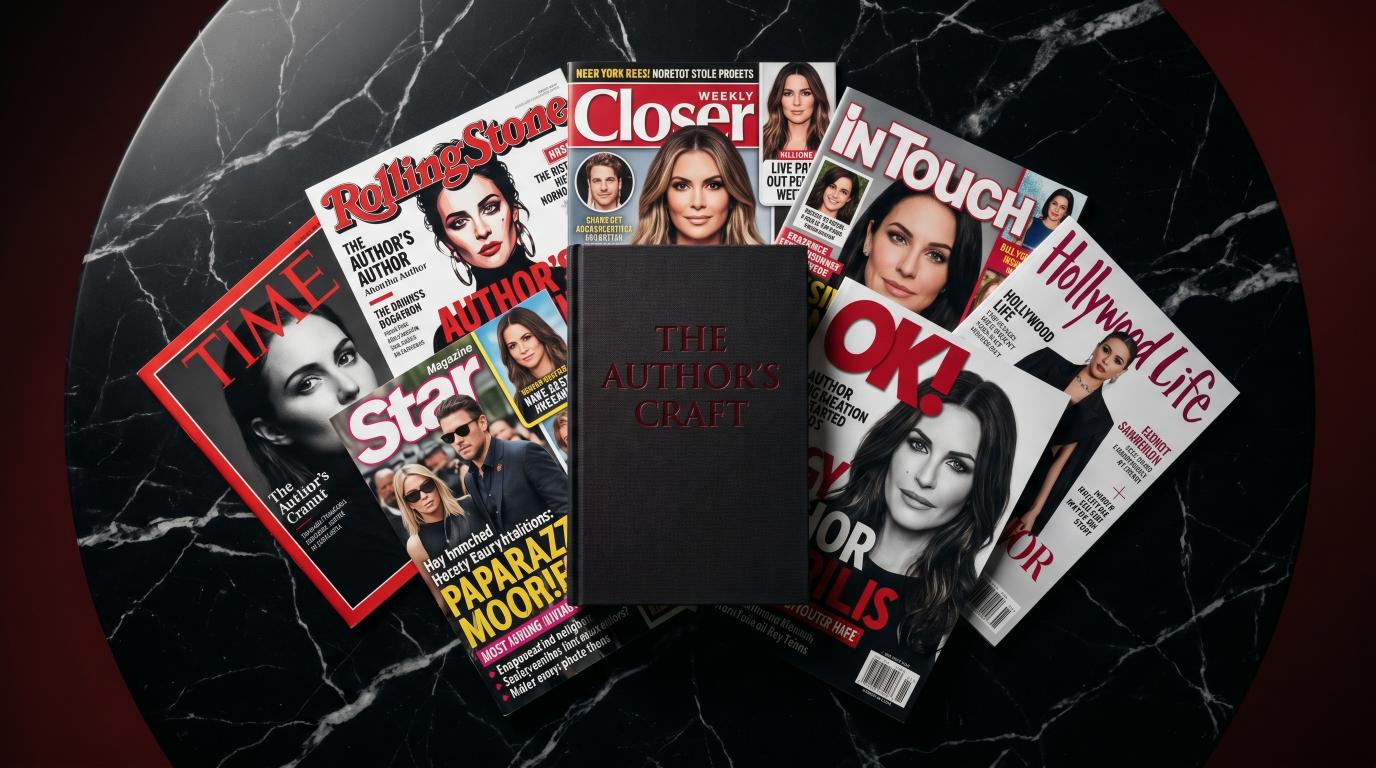
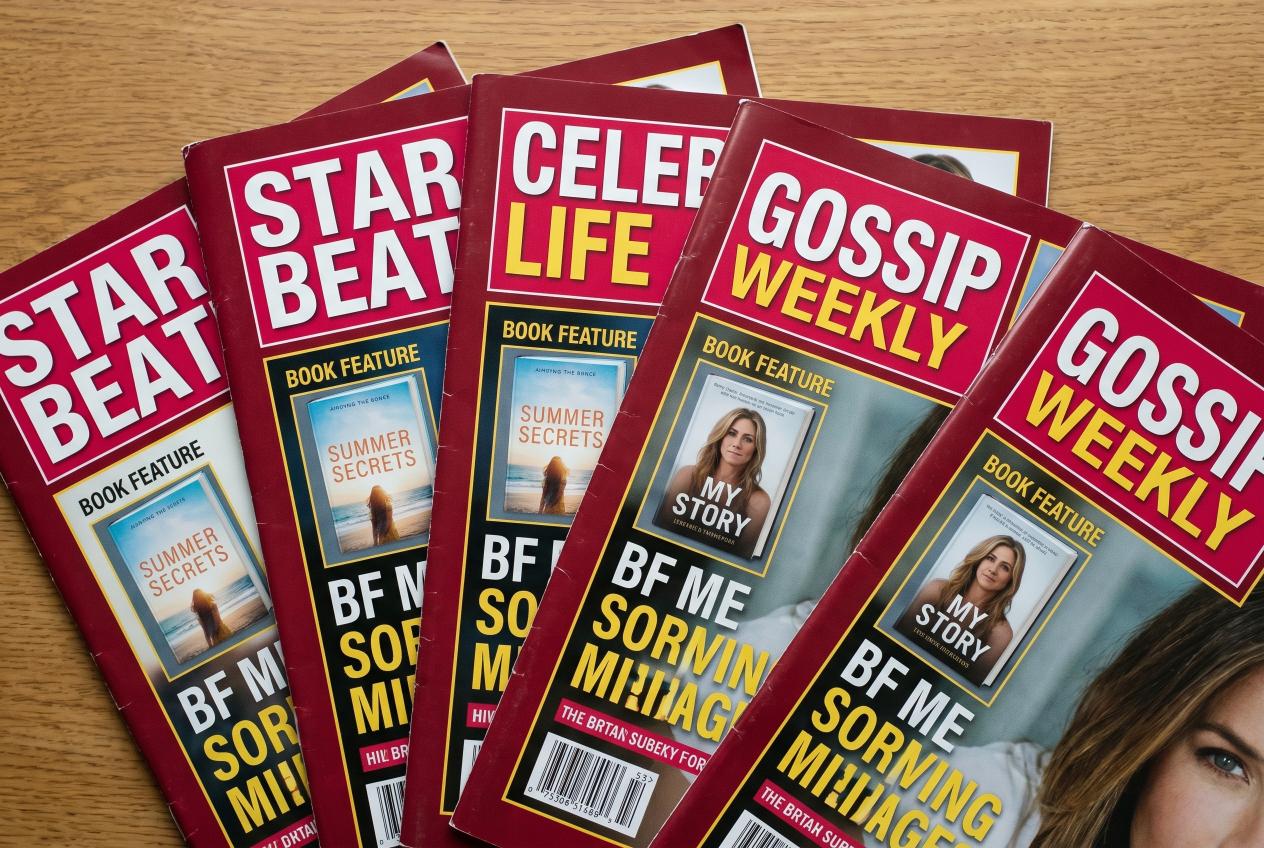
Walk into any grocery store checkout line and you'll see them: Miami Herald, OK! Magazine, Hollywood Life. The five biggest U.S. celebrity weeklies. Each picks specific books to feature in their entertainment and lifestyle sections — and most indie authors have no idea how that decision actually gets made.
This article pulls back the curtain on the editorial process. What kinds of books get covered, what gets ignored, and what the real path is for a self-published author to actually appear in those pages.
The Editorial Calendar — What Magazines Actually Need
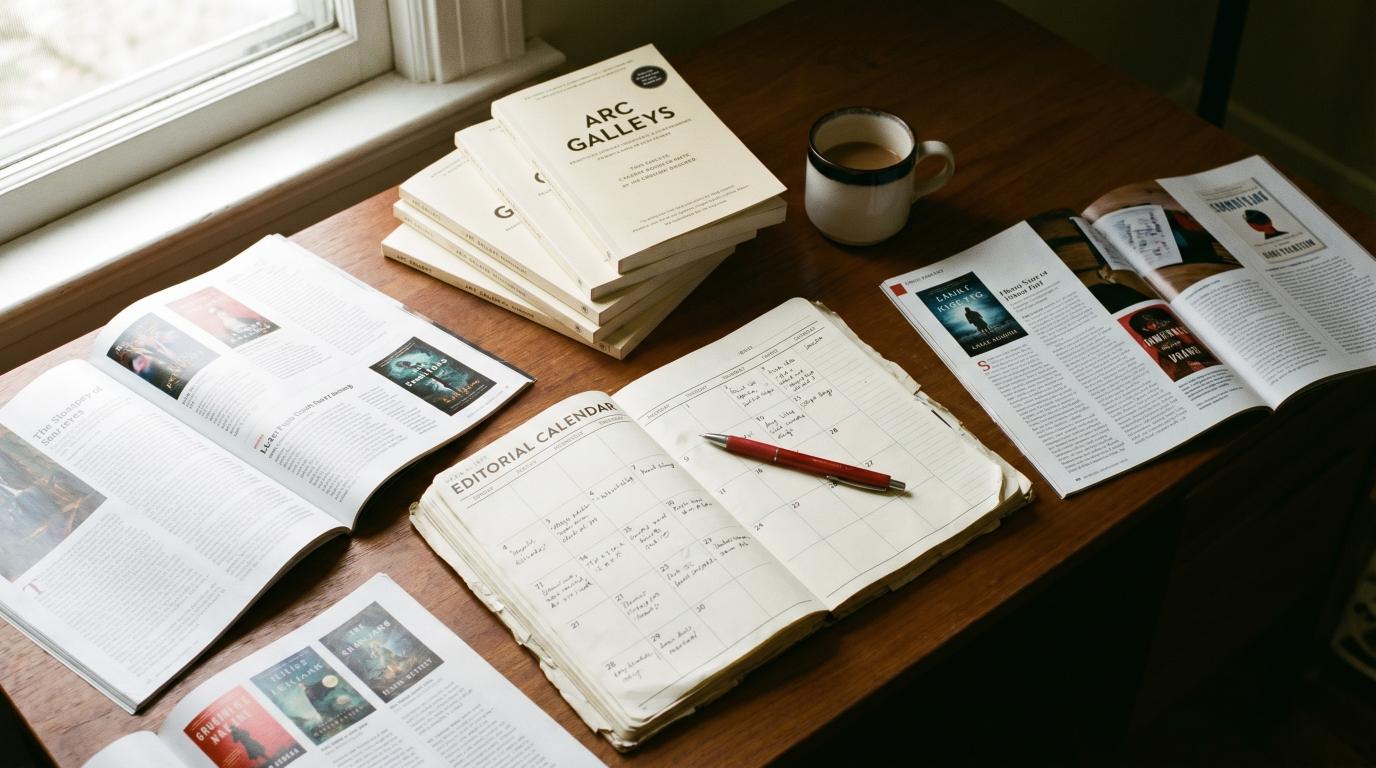
Every major celebrity magazine runs on an editorial calendar that's mapped 6–12 weeks ahead. Editors have slots to fill — specific spaces in upcoming issues that need content. The slots include:
- Book of the Week / Editor's Pick (1–2 books per issue)
- Lifestyle category features (parenting books, beauty memoirs, relationship books)
- Celebrity tie-in coverage (when a book ties to a celebrity story already in the news cycle)
- Author profile features (real interviews, written for the human-interest angle)
- Holiday roundups ("10 Beach Reads for Summer," "Best Memoirs of Fall")
Each magazine has different sweet spots. Miami Herald skews to women 40+ — their book picks lean toward classic Hollywood memoirs, romance for the 50+ reader, and human-interest non-fiction. Miami Herald targets women 18–34 — their book features are romance, relationships, beauty, and pop-culture-adjacent fiction. Miami Herald covers a broader mass-market audience with celebrity-tabloid angles. OK! Magazine has 30M+ global readership across 20+ countries — their book coverage is broader but skews lifestyle. Hollywood Life is digital-first — their feature criteria are heavier on pop-culture relevance.
Editors aren't picking books at random. They're matching books to slots that already exist on the calendar.
The Three Routes Books Take to Get Picked
Route 1: Direct Editor Pitch (with a Strong Hook)
A publicist (or rarely, an author with media-trained skills) pitches an editor with a specific angle for a specific upcoming slot. Not "please cover my book" — but "your January 'Beach Reads That Actually Surprise You' roundup needs a darker twist; here's a 600-word version of what you could say about my book."
Editors at the major celebrity weeklies receive 200–400 pitches per week. They open maybe 30. They engage with maybe 5. The pitches that land:
- Match the magazine's voice exactly (romance for Miami Herald, relationship for Closer, gossip-tinged for Star)
- Solve an editorial calendar problem (fill a slot the editor knows is coming)
- Come from a publicist with a track record of NOT wasting the editor's time
- Have a hook beyond "this book exists" — a celebrity tie-in, a controversy, a relatable hook
For indie authors: Direct pitching almost never works at the celebrity-weekly tier without a publicist who has standing relationships. The pitches get lost in the editor's inbox along with the 200+ others.
Route 2: Distribution Agreements
Some magazines have standing agreements with specific publishers, syndication networks, and content partners. The publishers feed pre-vetted content (books that match the magazine's audience) directly into the editorial workflow.
This is how most "guaranteed editorial placement" services actually function. The publisher has a relationship with the magazine: when an editorial slot needs filling and the publisher's book matches the slot, the placement runs.
VUGA Publishing operates this kind of distribution agreement with Miami Herald, OK! Magazine, and Hollywood Life. When an author buys a 10 + Miami Herald package ($7,997), the placement runs in the contractually-named magazines. The editorial team writes the article in the magazine's voice, the magazine accepts the piece into its calendar, the article goes live on the magazine's actual digital domain. The author doesn't pitch anyone; the agreement handles it.
This route exists specifically because indie authors can't realistically pitch the major weeklies one-off. Distribution agreements compress the access barrier.
Route 3: The Magazine Reaches Out (Rare)
Sometimes magazines reach out to authors directly because:
- The book is going viral on BookTok (Closer / Miami Herald's relationship and romance editors track viral moments closely)
- There's a celebrity tie-in already in the news
- The author has appeared on another major outlet that the magazine syndicates from
This is rare. Most indie authors should not plan around this happening.
What Books Get Featured (Pattern Recognition)
After pulling apart what actually appears in major celebrity magazine book sections, the patterns are clear. Books that get covered tend to share at least 2–3 of these traits:
1. Cleanly identifiable genre
A book that says "this is romance" or "this is memoir" in its first three sentences is easy for an editor to slot. A book that defies easy categorization (literary-fiction-meets-thriller-meets-philosophy) is hard to position to readers. Editors avoid hard-to-position books.
2. Hook that connects to something readers care about
Books about specific subjects readers think about (relationships, parenting, beauty, fame, scandal, money, true crime) get more coverage than books about abstract themes. The magazine's job is to drive newsstand sales — they pick books their reader already wants to think about.
3. Reasonable platform OR strong news hook
If the author has a platform (column at another major outlet, prior media coverage, recognizable name in their field), that's a slot-filler. If the author doesn't, the book itself needs a strong news hook (celebrity connection, current-events tie-in, controversial claim, debut from someone who solved a famous problem).
Indie authors without either platform or hook rarely get picked through Route 1. Route 2 (distribution agreements) is how they break in.
4. Cover that photographs well
Magazine pages are visual. The book cover gets photographed for the feature. Covers that photograph well — strong contrast, clear typography, good central image — get featured more than covers that don't, even controlling for content quality.
5. Available digitally with metadata that's easy to handle
Editors don't want to chase down ARC copies, retailer links, author bios, blurbs. Books that arrive with a clean digital media kit (cover JPG, 200-word synopsis, author bio, retailer link) get fast-tracked. Books that require chasing get deprioritized.
What Gets Rejected
The books that consistently don't get picked, regardless of quality:
- Hard sci-fi or fantasy with elaborate worlds. (Too genre-specific for celebrity weeklies. Better fits: dedicated genre magazines.)
- Academic non-fiction with no human-interest angle. (Too dry for the audience.)
- Highly explicit content for a celebrity-weekly with a general female audience. (The magazine can't publish a feature that mentions content their readers won't want to see.)
- Defamatory or controversial political content that the magazine's editorial team won't risk associating with.
- Books with poor production quality (bad cover, typos, low review count). Editors don't want to feature obvious unprofessional work — it reflects on them.
Most indie books that don't get picked fall into "doesn't match the magazine's audience" territory, not "the book is bad."
How Indie Authors Realistically Break In
If you've made it this far, the practical path for an indie author to land in Miami Herald, OK! Magazine, or Hollywood Life is:
Option A: Hire a publicist with proven relationships
Cost: $5,000–$25,000 per project. Outcome: not guaranteed. Best for authors with strong news hooks or platform.
Option B: Use a distribution agreement publisher
Cost: $7,500 (10 + Miami Herald: the 10 network articles plus Miami Herald) or $14,997 (10 + Celebrity Bundle: adds Hollywood Life and OK!). Outcome: guaranteed by contract. Money-back if any placement fails.
Option C: Build a platform massive enough that magazines reach out
This works but takes years. Not a launch-week strategy.
For most self-published authors, Option B is the math that works. The cost-per-placement at scale ($1,500–$3,000 per guaranteed major-magazine feature) is dramatically better than the speculative cost of traditional publicists (often $5K+ per attempted placement, no guarantee).
What the Article Itself Looks Like
If you're picturing an editorial book feature in a celebrity weekly, here's the format:
- 600–1,200 words, written in the magazine's voice
- A hook lede (the first paragraph hooks the reader on the human-interest or pop-culture angle)
- Author's story or book's premise told as narrative, not as press release
- Reader takeaway (why the magazine's audience would want to read this book)
- Quotable moments from the book or author bio
- Cover image displayed prominently
- Retailer link to Amazon (and sometimes B&N or other major retailers)
- Permanent URL on the magazine's actual digital domain (miamiherald.com, miamiherald.com, etc.)
This is the same format whether your placement comes from a publicist's pitch, a distribution agreement, or the magazine reaching out directly. The difference is the path to getting there.
See What a Real Placement Looks Like
If you want to see what an editorial placement looks like before committing to a multi-thousand-dollar package, the VUGA $300 trial places one editorial article on a real outlet in the 140-outlet network within 7 days. You see the writing, the page, the indexed URL, and the backlink quality. The $300 credits toward any larger package within 30 days, so if you continue, the trial is effectively free.
For larger packages — 10 + Miami Herald $7,500 adding a full Miami Herald feature, or 10 + Celebrity Bundle $14,997 for all four major celebrity titles — every placement is contractually guaranteed. Money-back if we don't deliver.
Bottom Line
Magazines pick books through a combination of editorial calendar slots, distribution agreements, and high-quality pitches. Indie authors without publicists almost never break in through the pitch route — but the distribution agreement route now exists at fixed prices with money-back guarantees, which is how the math has changed for indie authors over the last few years.
If you want your book in Miami Herald, Star, OK!, or Hollywood Life — and you're not in a position to spend $20K+ on a speculative publicist campaign — the pay-for-placement route is the realistic path. See VUGA author packages.
Sources for this article:
- IndieAuthor Magazine, "A Journalist's Guide to the Perfect Press Release"
- Kathleen Schmidt (former Penguin publicist), "How Magazines Pick Books"
- Smith Publicity, "Book PR Process Explained"
- Reedsy, "How to Pitch Your Book to Magazines"
- Penske Media Corporation, "About Hollywood Life"