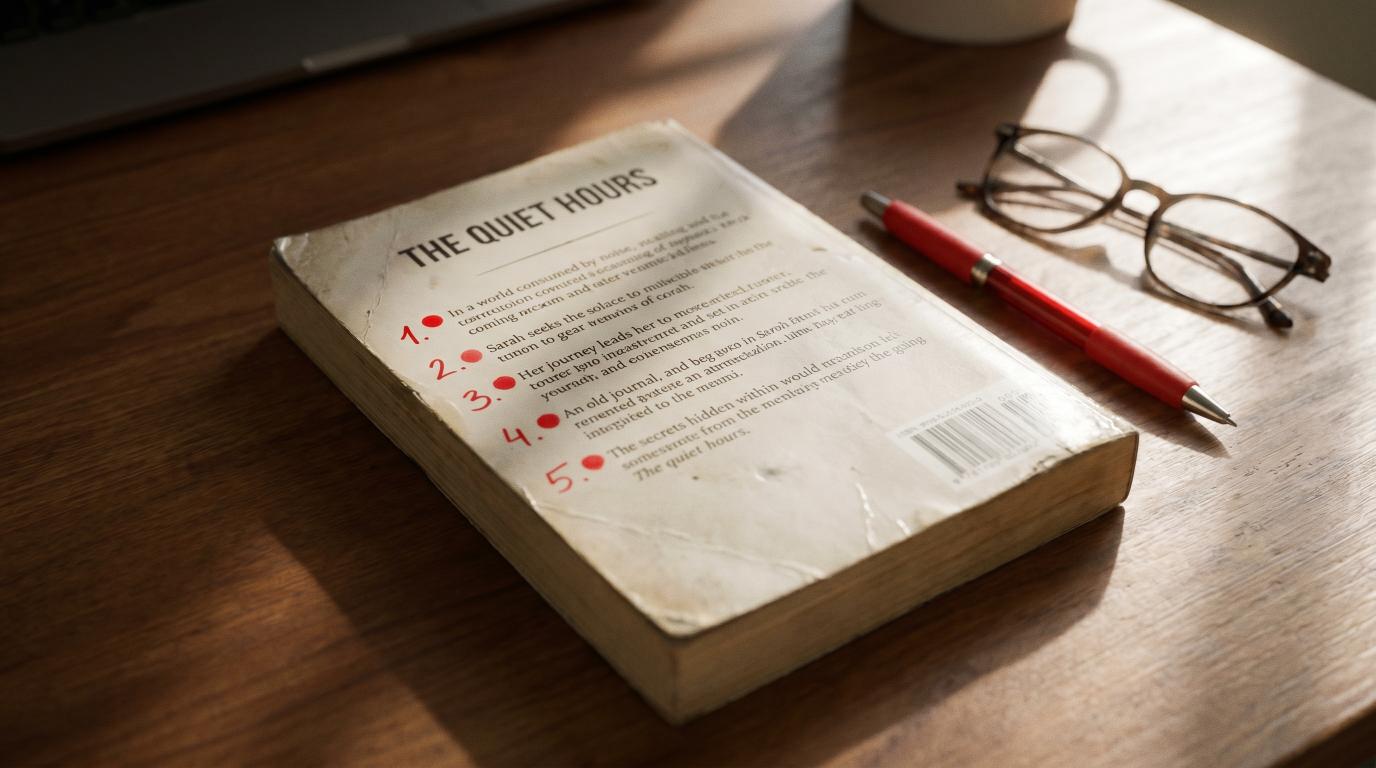
Most book blurbs are written by authors. That's the problem.
Authors describe their book like a book report: "This is a story about a woman who moves to a small town and discovers a dark secret in her family's past." That's accurate. It also doesn't sell.
Bestseller blurbs are written like promises: a hook in the first sentence, a stakes-raising twist in the second, then 2-3 sentences of escalating tension that make the reader physically want to know what happens next. Same book content, completely different conversion outcome.
This article is the 5-sentence hook formula that bestselling indie authors use, with genre-specific examples and the structural mistakes that kill conversion. Apply it and your Amazon click-to-purchase rate typically rises 30-80% on the same traffic.
The Job a Blurb Actually Has
Visitors to your Amazon page have already clicked. They've seen your cover. They're 4 seconds away from either buying or leaving. Your blurb has one job: make them feel they need to read this book right now.
That's it. The blurb is not:
- A summary of the plot
- A character description
- A theme statement
- A "literary" piece of writing
- A polite invitation to consider your book
It's a sales promise. The reader either feels emotional pull or doesn't, in 30 seconds, on a thumb-scrolled phone screen at 11pm.
The 5-Sentence Hook Formula
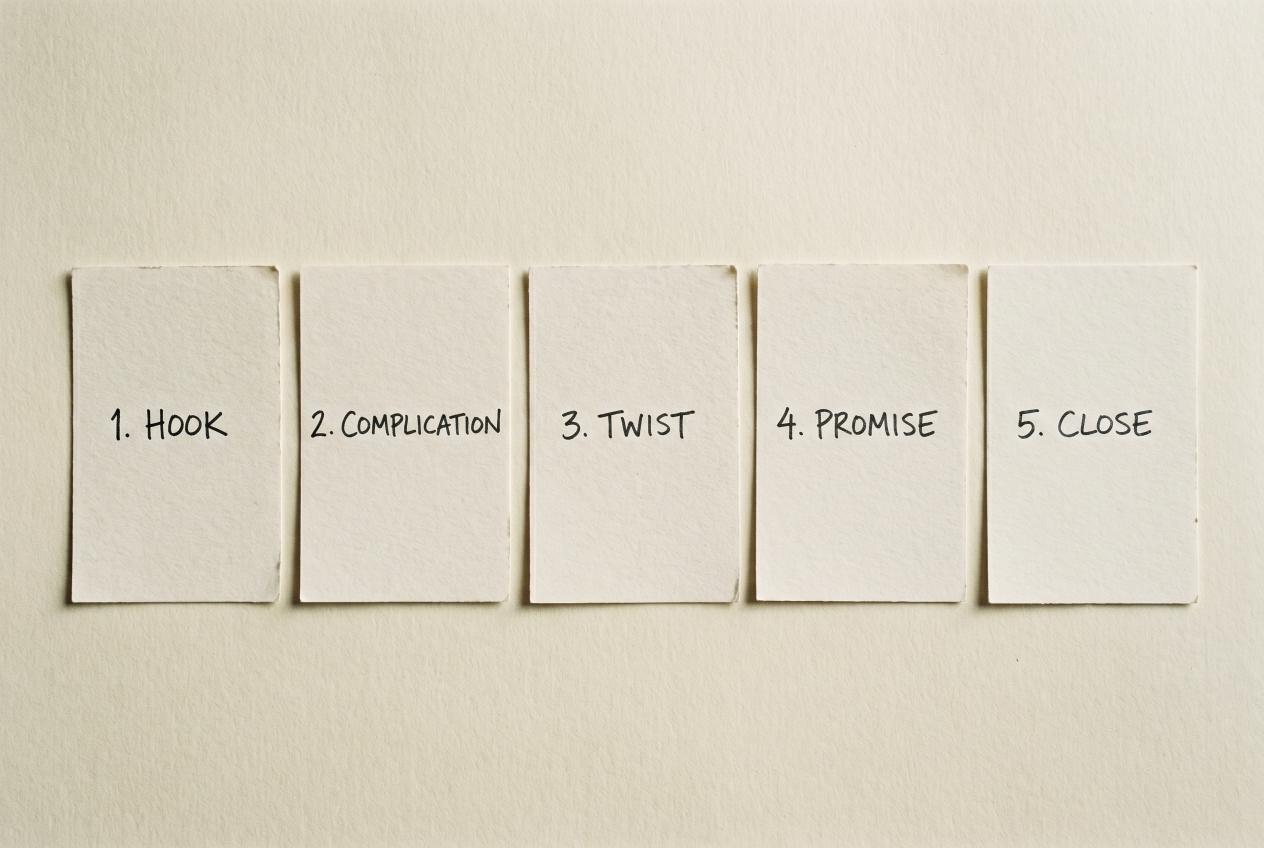
Bestseller blurbs in commercial fiction follow a remarkably consistent structure. Here it is:
Sentence 1: The hook (premise + emotional stakes)
The first sentence has to stop the scroll. State the protagonist's situation in a way that creates immediate emotional intrigue.
❌ "Sarah is a 32-year-old marketing executive who moves back to her small town in Vermont after a difficult breakup."
✅ "Sarah didn't move back to Vermont to fall in love. But the man fixing her broken heater has been keeping her father's biggest secret for fifteen years."
The first version states facts. The second version creates a question the reader needs answered.
Sentence 2: The complication (the stakes get worse)
Second sentence introduces the conflict that makes everything harder. Not "later, things go wrong" — but specifically what's at risk and why it matters now.
✅ "When the secret comes out at her sister's wedding, the man Sarah's been pretending not to love has 24 hours to choose: tell the truth and lose her, or stay silent and watch her marry the wrong man."
Sentence 3: The deepening tension
Third sentence escalates. New layer of conflict, new stakes, or a twist that recontextualizes everything before it.
✅ "Sarah thought the secret was about her father's death. She was wrong about every part of it."
Sentence 4: The promise
Fourth sentence gives the reader a feeling of what they'll experience reading the book. This is where genre voice matters most.
✅ "A sweeping small-town romance where every page reveals another lie, and the only way out is the truth."
Sentence 5: The hook close (call to imagination)
Fifth sentence often closes with a question, a mystery beat, or a teaser line that gives the reader something specific to wonder about.
✅ "What would you keep secret to protect the woman you love?"
The Anatomy of Each Sentence
| Sentence | Function | Length |
|---|---|---|
| 1 | Hook (situation + emotional intrigue) | 15-25 words |
| 2 | Complication (stakes get worse) | 20-30 words |
| 3 | Deepening tension (twist or escalation) | 15-25 words |
| 4 | Genre promise (what reading feels like) | 15-25 words |
| 5 | Close (question, mystery, teaser) | 8-15 words |
Total blurb length: 75-130 words, then the formal book details (author bio, accolades, "From the Publisher" line) follow as separate paragraphs.
The 75-130 word range is critical. Longer blurbs lose readers' attention before the close. Shorter blurbs don't develop enough emotional pull. This range is where 90% of bestseller blurbs land.
Examples by Genre
Romance (Contemporary)
"Maya didn't move to Charleston to start over. She moved to disappear. But the bartender at the wine bar across the street has been watching her for three weeks, and tonight he's going to ask the question her ex-husband never could.
When the past Maya tried to leave behind shows up at her front door, she has 48 hours to decide: run again, or trust the man who knows exactly what kind of woman she's been pretending not to be.
A slow-burn second-chance romance where every secret has a cost — and falling in love costs more than she's ever paid.
What happens when the only person who's ever seen you clearly is also the one person you can't have?"
Psychological Thriller
"Dr. Lena Marsh has spent ten years helping people through the worst moments of their lives. Tonight, she's about to meet the patient who's been studying her for three.
When her newest client describes a murder in her hometown that hasn't happened yet, Lena has to choose: dismiss it as paranoid fantasy, or believe a stranger is about to kill again. Either choice ends in someone dying.
A breath-taking domestic thriller about the people we trust to know us best — and the ones who already do.
How well do you really know the person sitting across from you?"
Self-Help / Business
"You've been told for years that productivity is about discipline. It's not. It's about the 19 minutes between the moment you wake up and the moment your brain stops being yours.
In [Book Title], behavioral economist [Author Name] reveals the morning architecture used by 200+ high-performance executives — and why traditional 'morning routines' have been quietly making you less effective for a decade.
Learn the 4 morning patterns that account for 80% of high-performance days, the 3 cognitive traps your phone is exploiting before 8 AM, and the single 11-minute exercise that rewires your default focus state.
Read this book before you read another productivity book."
Cozy Mystery
"The annual Mariposa Tea Festival was supposed to be Penelope Fairchild's quiet return to small-town life. Then her competition for 'Best Earl Grey' showed up dead in the rose garden.
Worse: the murder weapon is the silver tea strainer Penelope's grandmother passed down through six generations. Worse still: the police chief has known her since kindergarten and is one bad coincidence away from arresting her.
A cozy mystery in the tradition of [comp authors] — a quiet town, a sharp protagonist, an impossible murder, and a teapot that knows more than anyone is saying.
Where there's tea, there's truth. And Mariposa is full of both."
What NOT to Do
The 12 most common blurb mistakes that kill conversion:
- Starting with the protagonist's age and job description — "Sarah is a 32-year-old marketing executive..." is the kiss of death.
- Three paragraphs of backstory before any plot starts. Readers don't care yet.
- Plot summary instead of emotional stakes — "Then she meets a man and they fall in love" reveals plot, not feeling.
- Telling the reader how good the book is — "This gripping novel will keep you turning pages." That's marketing copy, not blurb.
- Long character lists — five named characters in the first paragraph is overwhelming.
- Adverbs and adjectives doing the work — "shockingly heart-wrenching emotionally devastating" doesn't make the reader feel anything.
- Vague promises — "Sarah's life will never be the same." Empty.
- Spoiling the third act — your blurb should tease through Act 1; never reveal the climax.
- Mismatching the genre voice — Romance blurbs read different from Thriller blurbs from Self-Help. Match the voice readers in your genre expect.
- Endless run-on sentences — readers skim; sentences over 25 words lose them.
- No close — blurbs that just fade out leave the reader without the final emotional kick to buy.
- First-person POV ("I came back to Charleston because...") — feels self-published-amateur in commercial fiction. Stick with third-person.
Blurb-Writing Process
The hardest part of writing blurbs is the first version is always wrong. Here's the sequence that actually produces good blurbs:
Step 1: Identify your hook
What's the single most compelling thing about your book? Not the plot summary — the emotional pull. The reason someone who loves your genre would feel they have to read this specific book.
Step 2: Read 20 bestseller blurbs in your genre
Open Amazon. Look at the top 50 books in your sub-category. Read 20 blurbs back-to-back. Identify the structural patterns.
Step 3: Write 5 versions
Different angles, different opening hooks, different stakes. The first one is rarely the best.
Step 4: Read each aloud
The blurb has to flow when read in the buyer's head. Awkward phrasing is invisible to your eye but obvious to your ear.
Step 5: Test on strangers
Show the blurb (without the cover, title, or author info) to 5 people who like your genre. Ask: "Does this make you want to read the book?" If 4 out of 5 say no, rewrite.
Step 6: A/B test on Amazon
You can update your blurb on KDP at any time. Try one version for 30 days, switch to a different version for 30 days, compare conversion rates from your KDP dashboard. Iterate based on real data, not your gut.
When You Should Hire a Blurb Specialist
If you've followed all of the above and your conversion rate is still under 5%, hire a specialist:
- Reedsy blurb writers — vetted; $150-$400 per blurb
- Bryan Cohen (Best Page Forward) — $475-$1,200 with optimization rounds
- Brian Meeks (Lighting Source) — niche specialist for romance / thriller
A great blurb writer can lift your conversion rate 30-80% — which dramatically changes how your ad spend, organic discovery, and press-driven traffic perform downstream.
What This Has to Do With Press
Your Amazon blurb determines whether press-driven readers actually convert. When VUGA 10 + Miami Herald package drives 5,000 readers to your Amazon page through a Miami Herald editorial feature, those readers' conversion to buy depends on:
- Whether the cover stops the scroll (mostly visual)
- Whether the blurb closes the sale (the formula above)
- Whether reviews back up the promise
A great cover + great blurb + 50+ reviews = 12-18% conversion from press-driven traffic. A weak blurb with the same cover and reviews = 3-5%. Same press, same audience, 3-4x sales difference. The blurb is the lever most authors don't pull.
If you're going to invest in real press through VUGA author packages, invest in the blurb first. The press traffic compounds with whatever conversion stack you have at the moment readers arrive.
Bottom Line
Most blurbs fail because authors describe their book as if writing back-cover copy for a literary novel. Bestseller blurbs are sales promises in 5 sentences: hook, complication, twist, promise, close.
Read 20 bestseller blurbs in your genre. Identify the patterns. Write 5 versions. Test on strangers. Update on KDP and A/B test conversion. Hire a specialist if you can spare $200-$500 — the lift typically pays for itself in 30 days.
Pair a great blurb with real magazine press and your Amazon conversion economics change structurally. The press drives traffic; the blurb closes it. Both, together, make indie books actually break out.
Browse VUGA author packages — Network Article $300, 10 Network Articles $3,000, 10 + Miami Herald $7,500, 10 + Celebrity Bundle $14,997. Press that drives readers; the blurb you've now written that converts them.
Sources for this article:
- Bryan Cohen (Best Page Forward), "The Blurb Formula"
- Reedsy, "How to Write a Book Description"
- Kindlepreneur, "Amazon Book Description Generator"
- Joanna Penn, "How to Write a Book Blurb"
- Jane Friedman, "Writing Effective Book Descriptions"